 admin
adminIn the wake of economic pressures, global tax shifts, and a demand for fiscal fairness, the Federal Government of Nigeria has enacted the most sweeping tax overhaul in decades — the Nigeria Tax Reform 2026. This new tax regime marks a fundamental re-engineering of how individuals, small businesses, and multinational corporations will be taxed starting January 1, 2026 — a date repeatedly emphasized by government authorities despite political debates. (State House Abuja)
This comprehensive guide explains the purpose, key changes, impact on Nigerians, business implications, compliance rules, controversies, benefits, risks, and how taxpayers should prepare. If you want to understand Nigeria’s tax reform, new tax brackets, corporate tax changes, personal income tax rates, or tax compliance requirements in 2026, this article answers all your questions.
1. Why Nigeria Needed Tax Reform
Before 2026, Nigeria’s tax system was complex, fragmented, and widely viewed as inequitable. The old framework included numerous outdated laws such as:
- Personal Income Tax Act
- Companies Income Tax Act
- Value Added Tax Act
- Capital Gains Tax Act
- Stamp Duties Act
- Petroleum Profits Tax Act
These laws were enacted decades apart, causing duplication, overlaps, compliance burdens, and unfair tax liabilities for ordinary Nigerians. (EY Tax News)
A central critique was that low-income earners paid a disproportionate share of personal income tax, while wealthier individuals and large corporations often used loopholes to reduce their liabilities. Indeed, about 96% of personal income tax collected was from low earners, a reality described as unjust and unsustainable by tax reform leaders
The 2026 tax reform aims to:
✔ Simplify tax compliance
✔ Broaden the tax base
✔ Protect low-income households
✔ Boost revenue sustainably
✔ Increase foreign and local investment
✔ Align Nigeria’s tax regime with global standards
2. Tax Reform Overview — What Was Signed Into Law
In mid-2025, four major tax reform bills were signed into law by President Bola Ahmed Tinubu. These were:
- Nigeria Tax Act (NTA)
- Nigeria Tax Administration Act (NTAA)
- Nigeria Revenue Service (Establishment) Act
- Joint Revenue Board (Establishment) Act
The first two — NTA and NTAA — take effect on January 1, 2026, while the other Acts commenced earlier in 2025.
The overhaul repeals and replaces multiple existing tax statutes with a consolidated modern framework designed for the 21st century economy.
3. Personal Income Tax Changes — Protecting Low And Middle Income Earners
Perhaps the most impactful change for everyday Nigerians relates to personal income tax (PIT).
a. New Tax-Free Threshold
Under the 2026 tax regime:
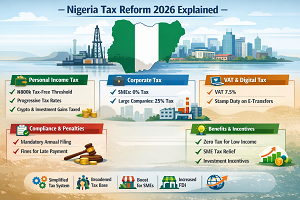
💡 The first ₦800,000 of annual income is tax-free for individuals. That’s a significant increase from previous thresholds, benefiting millions of workers — especially those on minimum wage.
b. Progressive Tax Bands
Above the exemption, income is taxed progressively:
| Annual Income (₦) | Tax Rate |
|---|---|
| ₦0 – ₦800,000 | 0% |
| ₦800,001 – ₦3,000,000 | 15% |
| ₦3,000,001 – ₦12,000,000 | 18% |
| ₦12,000,001 – ₦25,000,000 | 21% |
| ₦25,000,001 – ₦50,000,000 | 23% |
| Above ₦50,000,000 | 25% |
This new structure means that:
✔ Minimum wage earners pay no personal income tax.
✔ Moderate-income earners enjoy lower effective tax rates.
✔ Only high-income earners pay up to 25%, which remains competitive compared to some regional peers. (The Nigerian Inquirer)
c. Expanded Taxable Items
Under the new law, taxable income now includes:
✔ Salary and wages
✔ Rent income
✔ Interest (including FX gains)
✔ Crypto and digital asset gains
✔ Investment returns
This inclusion ensures a broader and fairer base, particularly in the digital economy.
d. Allowable Deductions
Certain deductions remain or are newly introduced, including:
- Pension contributions
- Life insurance premiums
- Rent relief (20% of annual rent paid, capped) (The Nigerian Inquirer)
These deductions help reduce taxable income and encourage savings and investment.
4. Corporate Tax Reform — Incentives and Simplification
a. Corporate Tax Rates
Under the new regime:
✔ Small companies with turnover below ₦100 million pay zero corporate tax.
✔ Large companies may pay corporate tax rates reduced from 30% to as low as 25%, subject to presidential directives aimed at improving competitiveness. (Nairametrics)
This reform is expected to stimulate small and medium enterprise growth (SMEs) by lowering entry barriers and easing compliance. (Nairametrics)
b. Simplified Levies
Several overlapping levies such as:
- Tertiary Education Tax
- Police Trust Fund Levy
- NASENI Levy
- NITDA Levy
have been merged into a single 4% Development Levy for medium and large enterprises. This simplifies compliance and reduces administrative duplication. (The Nigerian Inquirer)
c. Free Zones and Investment Incentives
Export-oriented and free zone businesses remain incentivised, and the law introduces a tax credit regime for eligible priority sector investments. (Nairametrics)
5. VAT, Digital Transactions and Stamp Duties
a. VAT Remains at 7.5%
Nigeria’s Value Added Tax (VAT) continues at 7.5%, but basic necessities like food, transport, healthcare, and education are zero-rated, reducing the burden on low-income households. (Legit.ng – Nigeria news.)
b. Stamp Duty and Electronic Transfers
Electronic transfers above certain thresholds now attract formal stamp duty, applied to senders on transfers above ₦10,000. Payroll transfers and intra-account transfers are exempt. (The Nigerian Inquirer)
6. Compliance, Filing, Penalties & Legal Enforcement
A modern tax system requires strong compliance rules:
✔ Annual filing is mandatory for all taxpayers, even if no tax is owed.
✔ Individuals must file by June 30; companies by March 31.
✔ Late filing triggers fines starting at ₦100,000 plus monthly charges.
✔ Non-payment attracts interest tied to the Central Bank rate. (The Nigerian Inquirer)
The new regime also enables data sharing across government agencies to close loopholes and curb evasion. (The Nigerian Inquirer)
7. Who Benefits Most From the Reform?
✔ Low and Middle-Income Workers
Most ordinary workers will enjoy:
✔ Zero tax on incomes up to ₦800,000
✔ Lower tax bands
✔ Expanded deductions
✔ Fairer progressive tax structures
Government projections suggest approximately 98% of Nigerians will pay little or no tax or receive significant relief under the reform. (The Nigerian Inquirer)
✔ Small Businesses & SMEs
Companies with modest revenues will benefit from corporate tax exemptions, simplified levies, and lower compliance hurdles, enabling faster formalisation and growth. (Nairametrics)
✔ Investors and the Business Community
Clearer tax rules, reduced rates, and internationally aligned standards boost investor confidence, attracting foreign direct investment (FDI). (EY Tax News)
8. Challenges and Public Concerns
Despite its intentions, the 2026 tax reform has sparked debate and controversy:
a. Public Skepticism and Economic Anxiety
Many Nigerians expressed worry that higher tax rates and increased enforcement would squeeze already tight household budgets. Critics suggest that economic challenges — inflation, insecurity, joblessness — may worsen before benefits are felt. (The Guardian)
b. Political Backlash
Lawmakers have debated re-gazetting and reviewing elements of the reform, reflecting political tension over legislative procedures. (Arise News)
c. Implementation Risks
Enforcing compliance fairly across a large informal sector remains a challenge. The government has responded by emphasising public education and technology-enabled tax administration. (Nairametrics)
d. Personal Pressures For Reform Leaders
Tax reform architects, including Chairman Taiwo Oyedele, have reported personal threats, revealing the intensity of public discourse around the reform. (Ripples Nigeria)
9. Practical Tips for Nigerians — How to Prepare
To navigate the 2026 tax landscape.
Also Read. Top Online Platforms That Pay Nigerians in Dollars
✔ Understand Your Tax Bracket
Know which band your income falls under to estimate your tax liability accurately.
✔ Register for Proper Identification
Ensure your Tax Identification Number (TIN) is linked with your National Identification Number (NIN) — a requirement for many financial and formal activities.
✔ Keep Accurate Records
Maintain documentation for:
- Rent receipts
- Pension/pension contributions
- Life insurance premiums
- Investment income
These can reduce taxable income.
✔ Use Tax Software or Professional Services
Consider digital tax tools for tracking income, deductions, and filing returns.
✔ Stay Informed
Government agencies and tax professionals will release more guidance as implementation rolls out.
10. Final Thoughts — A New Era for Nigerian Taxation
The Nigeria Tax Reform 2026 is more than a policy change. It represents a structural shift in how the country generates revenue, treats its citizens, and positions itself on the global economic stage. While it promises fairness, simplicity, and growth, success depends on transparent implementation, taxpayer education, and strong institutions.
For individuals, the reform should mean higher disposable income, better compliance clarity, and less tax burden relative to their earnings. For businesses, especially startups and SMEs, the system opens doors to growth, investment, and formalisation. International investors gain a modern, predictable framework aligning with global tax norms.
Ultimately, the reform’s impact will be judged not just by the laws on paper, but by how effectively they boost revenue, support public services, encourage investment, and improve the everyday lives of Nigerians.


 admin
admin